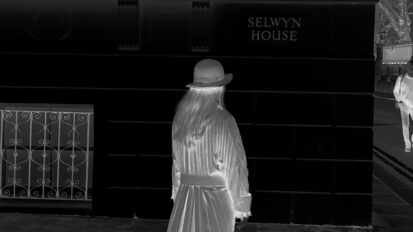
Black and white Portrait of photographer and filmmaker Monika K. Adler.

MONIKA K. ADLER

ABOUT

Monika K Adler, is an acclaimed photographer and filmmaker who has exhibited her work worldwide.

With over 25 years of professional experience in London, Paris, and New York, Monika has worked on many high-profile projects, including First Open for Christie’s auction house, Rankin’s 2020 for Sky Arts TV, and 209 Women for the UK Parliament.

Between 2013 and 2023, Monika K Adler was represented by Art & Commerce and Vogue Italia and over the years has judged a range of high-profile international photography competitions, including the Golden Shot Awards and Monovisions.

In 2018, she was nominated for the Royal Photographic Society’s Hundred Heroines Award for her outstanding contribution as a female photographer.

Monika is currently working on two feature films, Sick Bacchus and One Hour After Violent Death.

Born during the collapse of communism, my childhood was spent between my grandfather’s cinema and the psychiatric hospital where my grandmother worked. I silently observed the fragility of human nature and learned early on that sanity is political and reality is negotiable.  Madness felt genuine, while cinema felt prophetic, and reality itself seemed staged.

I didn’t fit in and refused to try.  Early difference is punished but also sharpens instinct.  I escaped to art school in Warsaw, not to be trained but to be contaminated. Five years immersed in films, cafés, exhibitions, and nocturnal conversations taught me to see sideways, read between structures, and live without permission.  I chose disappearance, a year of isolation, and used tarot as a mirror. I became The Fool: a sacred idiot, fearless initiator, leaping from radical trust, not ignorance. Photography followed. Paris freed me, New York devoured me, and Europe never let me rest. I arrived in London with nothing left to defend. That’s where love rewired me. Where fulfilment replaced survival.

I am no longer the Fool. I am the Trickster. Shape-shifter. Disruptor. Saboteur of stagnation. I exist to fracture comfort and seduce change. If this unsettles you, good. If it attracts you, even better.

@monikakadler

MONIKA K ADLER, OFFICIAL SITE. Monika K Adler is an acclaimed photographer and avant-garde filmmaker based in London, The United Kingdom.

Latest

  • “Born in Poland, Monika K. Adler grew up in an Eastern Europe suffused with memories as well as more tangible reminders of large-scale assaults on human bodies, particularly female bodies, motivated by ideology and ethnic hatred. From the Nazis, to the Soviet invaders (who victimised her grandmother’s cousin) to the rape wars of nearby Serbia, the history of the degradation of the body haunts the imagination of this brilliant young photographer and filmmaker. Yet her works are not exercises in feminist or political filmmaking, such polemics are too obvious and reductive, failing to capture the deeper reality that she seeks to evoke: a reality that eludes easy definitions and explanations and that perhaps derives from – or more likely informs – the unconscious mind of human beings.

    The spectre of historical trauma, the manifestation of mystery and desire in the human body, the experience of women as objects and victims of outmoded and pernicious institutions which nonetheless continue to exercise an influence on our thoughts and behaviours, are just part of what Adler’s work addresses.

    In Adler’s photographs both human beings and objects emanate a sense of abandonment or otherness, strange and liminal manifestations existing on the border between our familiar world and some mysterious and ineffable dimension not amenable to full disclosure or to rational discourse. Twilight glimpses of the troubled dreams that infuse our apprehension of this world if not a phantasm of another realm that at moments of extremity or disruption impinges on this one.”

    From The Ambivalent Body: On The Short Films Of
    Monika K. Adler, Robert Smart, 2013

    Robert Smart © 2013
  • “Deep and powerful, personal, encoded, cryptic, ominous and ambient iconography and symbolism. Made public, shared, maybe even enforced and inflicted. Open to, allowing, encouraging and provoking interpretation and other engagement. Production and end-result as therapeutic action.

    A constant state of cease-fire and false-security, both to the pleasant menace, but also the disturbing charm, which together are the magic. Adler’s exact means of production remain mostly undisclosed, joining forces with the power and beauty of the mystery and enigma”

    From the essay ‘Monika K. Adler’ by Douglas Park, 2013

    Douglas Park © 2013
  • “At first glance, Monika K. Adler’s work recalls that of fellow eastern European photographer Jan Saudek. Solitary subjects, nostalgic sepia-tones, a focus on feminine beauty ? in cell-like settings. But where Saudek’s caged birds exist in a timeless isolation, the outside world may more rudely intrude in Ms Adler’s tableaux vivants.
    At least that’s the case for the photo which became known as Mademoiselle Guillotine at its Paris exhibition earlier this year ? the best example I have seen of her talent for finding a potent semiotic nexus.
    The image shocks with the force of its clashing religious and cultural symbols, its dialectical dynamics of covered face, exposed genitals; naked beauty, naked vulnerability; sexual power, sexual humiliation. It alludes to the contemporary political context. The picture draws strong reactions from spectators, who suddenly find themselves voyeur/participants in a
    would-be war crime scene. Here we have the mainstay subject of the female
    nude updated to the unfortunate era of Abu Ghraib.
    This work unites art and politics in the polemical style of John Heartfield’s anti-Nazi photomontages. It is a hyperrealist mise en scène with a lexicon
    drawn from news media iconography. It blurs photojournalism and art photography, stripping away manipulation and ideological pretence in the
    process. What’s left is a withering commentary, the coup de grace, delivered
    in the satirical title: Democracy.
    The irony is that where Saudek’s boldest work had humanity literally gazing
    into its own anus in the shadow of the Iron Curtain, the other side, Adler seems to retort, is only a rape scene.”

    Photography as a Weapon Of Resistance – Mark Birdsong, Paris, June 2005

    Mark Birdsong © 2005